Hyeree Ro’s Road to Venice
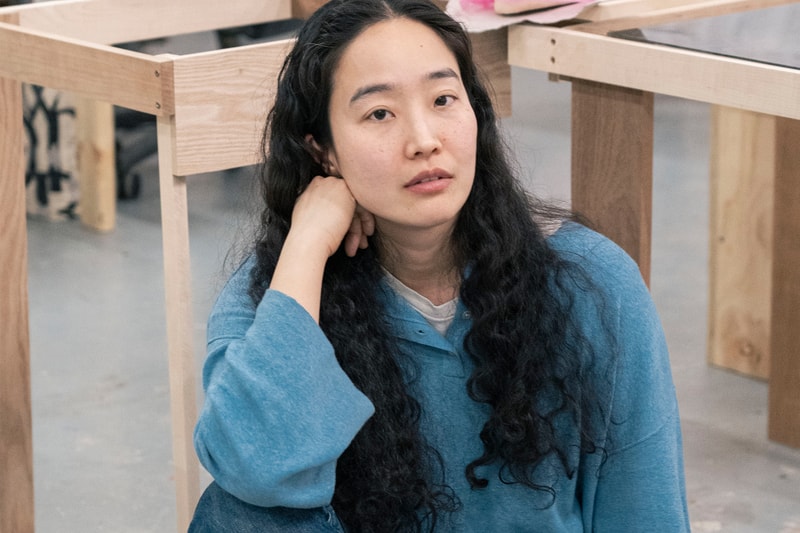
Hyeree Ro ’s artwork has a way of holding you. Equally as important, it knows when to let you go. In her Brooklyn studio last winter, I watched as she dipped gold-rimmed organza circles into warm baths of beeswax, securing them together wit…
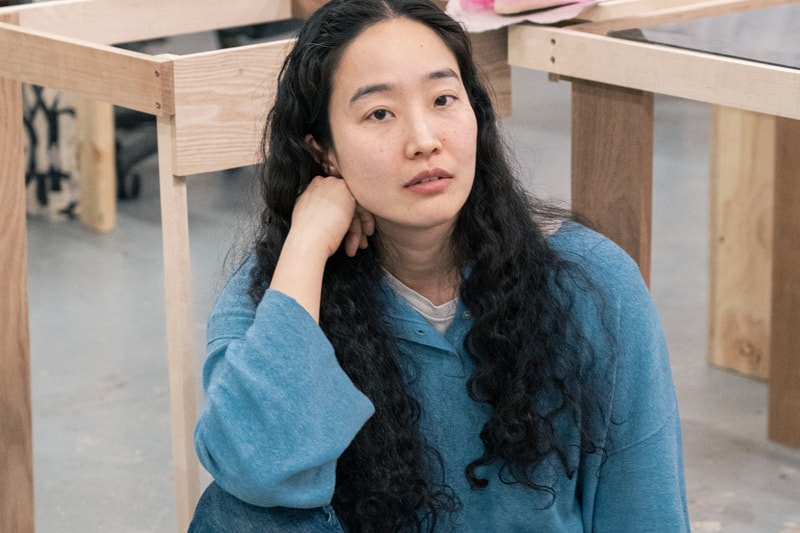
Hyeree Ro’s artwork has a way of holding you. Equally as important, it knows when to let you go. In her Brooklyn studio last winter, I watched as she dipped gold-rimmed organza circles into warm baths of beeswax, securing them together with affectionate hand-stitches.
“Each circle is small and fragile, but when they’re together, they’re strong, resistant.” she tells Hypebeast, layering one piece to join a sweeping, membranous sheet. There’s a quiet, mesmeric magic to watching an artist lock into her craft. And for Ro, it’s game time.
Organza, a material commonly used in Italy and East Asian ceremonial traditions, is a fitting introduction to the artist, who is representing South Korea at this year’s Venice Biennale. Her studio brims with evidence of “Bearing,” her presentation at the Korean Pavilion, paired beside “Meridian” by Goen Choi. Stray bone-shaped clay forms sleep on hand-built tables. Piles of pistachio shells dipped in graphite and gold rustle near rocks collected from beaches all over. Small found objects make up a wandering archive of life, each waiting for their next arrangement.
Born in Seoul and now based in Brooklyn, Ro moves between sculpture and installation in what she calls “fractured narrative-based performance.” Shaped by early years split between Korea and the U.S., her practice circles questions of family, memory, migration and belonging. For her, stories are always alive, carried through bodies, place and language.


No one word can cleanly sum the Biennale. For this year's “art world Olympics,” political tension is particularly heavy on the mind, kicking off with protests shutting down pavilions and the International Jury resigning en masse. Following suit, nearly a quarter of participating pavilions have withdrawn from awards consideration in solidarity. At the Korean Pavilion, however, such instability is the animating force behind Liberation Space: Fortress/ Nest.
Curated by Binna Choi, the exhibition takes cues from the years following Korea’s liberation from Japan, whose pavilion is directly next door. “That period is often remembered as chaotic or unfinished,” Choi explained on opening day. “But instead of seeing it simply as a failed or tragic moment, I wanted to think of it as an ongoing movement that we continue to participate in and shape.”
The dream of world-building, as Choi points, is long game, a fleshy, unfinished condition still unfolding 70 years on. With history at the forefront of Liberation Space, this edition also marks a first for the two countries: a cross-hedge collaboration between Korea and Japan throughout the event's duration, starting with a shared opening ceremony earlier this month.


“Art was a savior to me.”
Ro's Biennale presentation is a natural extension of the relational thinking that already defines her practice. Only now it’s scaled out, moving into ideas of new life, futurity and wrestling what it means to create with a nation or movement behind you.
Back in Brooklyn, sunlight spills through suspended sheets of organza, flickering like fish scales beneath water. Ro walks me through a miniature model of the pavilion, peppered with tiny replicas of the work. She traces the small scalloped train inside, forming pathways, thresholds and boundaries through the space – a pavilion within a pavilion. In “Bearing,” softness is strength.
“Binna thought of my visual language as nest-like — something that’s incubating, embracing,” she explains, gaze fixed on the works. “A nest is a place you grow, are supported by. But you also need to leave your nest and go out into the world.” With only weeks before the works ship to Venice, a steadiness hums through the room, echoing the natural composure of her character.
“A nest is a place you grow, are supported by. But you also need to leave your nest and go out into the world.”
Paging through publications from years prior, Ro reflects on the arc of her career. As a child, she dreamed of being an artist, though that path to actually becoming one wasn't so plain and simple. She came into translation as a teenager – first for her father, a landscaper in California, then as a volunteer at a migrant workers center in Ansan back in Korea. At one point, becoming a lawyer seemed like the obvious next step. She pursued a first bachelor’s studying Law at Yonsei only to pivot after graduating. “[Back then,] art was a savior to me.” Finding courage to change course, she returned to school for a BFA and, eventually an MFA in sculpture at Yale.
“Where my heart was then, and where it is now, hasn’t changed,” she says. “But the way I want to move forward with those thoughts has shifted into the language of art.” Art became a more indirect, almost affectionate mode of address — one that enchants and demands by suggestion. “The world is dominated by only a few narratives, and I want to keep adding more. If we hear more stories, there’s hope for change.”


“If we hear more stories, there’s hope for change.”
“I’m thinking about meaning in terms of bearing a child, to change direction, to endure,” she muses during another one of my visits. Alongside the organza piece, she's bringing eight work stations to Liberation Space, each speaking to an essential act of life: mourning, remembering, observing, living, repairing, sharing and planning. “What kind of person would I like to live as? If I have a child, what kind of person do I want them to grow up to be?” Such questions alchemize the works. “What kind of world will they want to build?”
The stations sit, waiting to be activated by visitors and pavilion staff. The “Repairing” station, for instance, is a custom setup for mending the organza sheets as they fall apart during the exhibition period. She twirls wooden forms in her hands, later to become “Sharing.” True to bearing, some of the stations also function as keepers, hosting companion works by five fellows, “embracing them without clear distinction,” to make a kind of single, “collective body.”
“Mourning,” shelters “Funeral,” a sculpture by Nobel Prize-winning writer Han Kang, based off of the opening dream sequence of her novel We Do Not Part. Nearby, “Remembering” embraces “Gwangju Lessons,” a 74-piece linocut series by Rwandan-Dutch artist Christian Nyampeta, and Yezoi Hwang’s revolving constellation of protest photography, all shot on disposable cameras during the 2024 martial law crisis.


By April, most of the works have already touched down in Venice. She's putting final touches on a work during a phone conversation. There's more to be done, but the journey so far has been nothing short of gratifying, she expressed. The countdown nears zero, but “completion” is not necessarily the point: “We really want the pavilion to be living through movements and the people visiting.” Seven “bearers” — young artists — will “take care” and “activate” the presentation, with their own practices and documentation contributing to the 2027 homecoming show. “There’s an enlivened essence that’s important to the project.”
It’s difficult to distill what it means to be part of something as storied as Venice. Even Biennale artists, Ro notes, aren't safe from imposter syndrome. Over the months of knowing her, I saw expectation and pressure soften into recognition, and with “Bearing” up, what is she taking away?
“I love being an artist,” she said candidly. “To make things with others and prove yourself wrong. It’s not new something I’ve learned, but always a valuable realization to have.”
Images by Donghwan Kam, Orlando Thompson and Hyunjung Rhee. Courtesy of the artist and the Korean Pavilion, 2026 Venice Biennale.
Source: Hypebeast — Read original